glaciers and ice sheets
glacier, ice-sheets and sea-level rise
Glaciers and ice sheets are major contributors to sea-level rise. Predicting how quickly they will lose ice requires models that represent the processes controlling surface mass balance and how these respond to a changing climate. My work has included developing new glacier and ice-sheet processes for climate models and using them to investigate future ice loss and sea-level rise.
Representing glaciers in JULES
As part of the High-End Climate Impacts and Extremes (HELIX) project, I developed the representation of glaciers within the JULES land-surface model. This included introducing elevated ice tiles, allowing glaciers at different elevations to be represented within a single model grid cell. This is important in mountainous regions, where climate varies strongly with elevation and glaciers may occupy only a small part of the landscape. I then used JULES with an ensemble of climate-model projections to estimate future glacier volume loss under high-end warming scenarios. By the end of the century, the simulations projected global glacier loss equivalent to around 215 mm of sea-level rise, with larger losses possible when uncertainty in the glacier model parameters was included.


Meltwater and the Greenland ice sheet
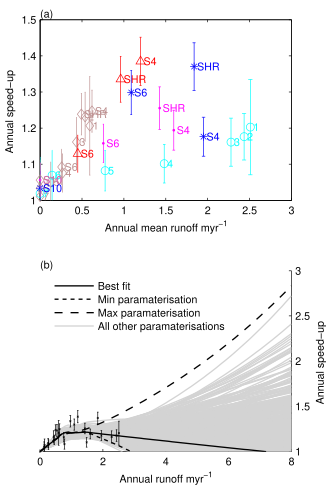
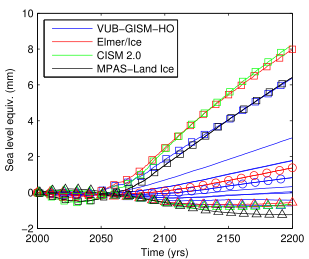
For the ice2sea project, I developed a parameterisation describing how surface meltwater can affect the movement of the Greenland ice sheet. Meltwater can reach the base of the ice sheet and temporarily increase ice flow by reducing friction between the ice and the bed. The parameterisation was implemented in four ice-sheet models to investigate how this process might affect future sea-level rise. The experiments showed that although increased surface melting can speed up the ice sheet locally, the resulting additional contribution to sea-level rise is relatively small compared with the direct loss of ice through increased surface melting.

Comparing glacier models
I also contributed to the Glacier Model Intercomparison Project (GlacierMIP2), an international effort to compare global glacier models and understand the causes of uncertainty in projections of future glacier change. I contributed JULES simulations to the model comparison. The study showed that uncertainty in the glacier models is particularly important for projections over the next few decades, while uncertainty in future emissions becomes increasingly important later in the century and dominates global projections by 2100.

Why this matters
Sea-level rise is the end result of a chain of processes: changes in the atmosphere affect snowfall and surface melt, which alter glacier and ice sheet mass, and this in turn changes the amount of water entering the ocean. Representing these links in models helps us understand which processes matter most, where the main uncertainties come from, and how sea-level rise may change as the climate warms.